

The sacred beach where history meets legend
Anakena Beach, with its coral-white sand and turquoise water, is not only the most beautiful of the Easter Island, but also its most sacred place. Legend and archaeology merge here: King Hotu Matu'a and the first Polynesian settlers landed here over 1,500 years ago and laid the foundation for the Rapa Nui civilization.
Two magnificent ahu—stone ceremonial platforms—rise up here. Their moai have been looking inland for centuries as silent guardians of this cradle of ancestors. More than monuments, they connect us to the spiritual heritage of the island—and the culture that inspires our brand, Anakena—Natural Cosmetics.
Ahu Nau Nau: The Seven Guardians
The best-preserved moai on the island
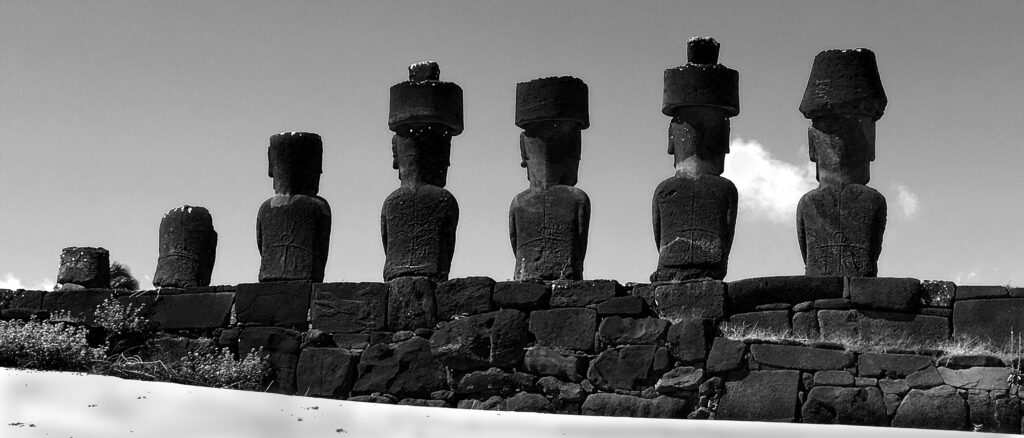
Ahu Nau Nau stands majestically in the middle of Anakena Beach: a 70-meter-long platform with seven beautifully restored moai. Their secret? They were buried under sand for centuries, protected from wind, rain, and sun. This preserved the fine details on their backs and bodies—unlike most of the island's statues.
One interpretation: they represent young deceased members of the royal family, whose gazes wander across the bay to their ancestors.
The name and its meaning
„Nau Nau“ refers to the naunau or nau opata, an extinct relative of sandalwood. Its fragrant wood was suitable for perfume, its nutritious nuts for survival rations. Legend: King Hotu Matu'a brought them from his homeland for the first few months on the island.
The Pukao: Powerful Headgear
Four moai wear red pukao—cylindrical „head knots“ made of scoria stone from the Puna Pau crater. Some weigh several tons and were added later. They symbolize tied-up hair or insignia of high mana (spiritual power).
The discovery of the Moai eyes
1978 during excavations in Ahu Nau Nau: 57 coral fragments – eyes made of white coral with tool marks. The find proved that moai once had eyes! Four fragments form almost a complete pair, exhibited in the Museo Antropológico Padre Sebastián Englert on Easter Island.
With obsidian or red scoria pupils, they seemed alive—bridges between the living and the ancestral world.
Ahu Ature Huki: The first re-erected moai
Milestone in modern restoration
To the right, at the foot of Maunga Hau Epa, stands Ahu Ature Huki with its solitary moai—the first to be rebuilt in modern times. Historically invaluable, if less famous.
In 1956, Thor Heyerdahl and 12 locals lifted this 3-meter colossus (30 tons) using traditional methods: stones, wooden poles, and ropes over a period of 18 days. In „Aku Aku,“ he describes how Mayor Pedro Atan provided the helpers. The success showed that the Rapanui people managed it with wood, stone, and ingenuity—without modern technology. He ushered in the era of restoration.
Cultural and spiritual significance of the ahu
More than stone platforms
Ahu are the heart of Rapa Nui culture: places for burials, worship, and celebrations. Ancestral moai watched over them and bestowed mana (protection and power).
The statues look inland—toward the villages and fields of their descendants. In this way, they protect as mediators between the mortal and spiritual worlds.
Astronomical alignment
Many ahu, including Anakenas, follow celestial events. Coastal ahu face equinoctially or north-south, moai east or west. They marked farming seasons and festivals—religious, social, practical.
Archaeological evidence of the ancient settlement
Anakena is archaeologically one of the oldest settlements—200–300 years before the first ahu. Excavations have uncovered older platforms, paenga house foundations, earth ovens (umu pae), and manavai gardens.
Near Ahu Nau Nau: Foundation stones of the alleged Hotu Matu'a house – huge, oriented north-south. This reinforces Anaken's role as the founding place.
Territory of the Miru Clan
Anakena belonged to the powerful Miru clan, which provided the Ariki Mau and traced its origins back to Hotu Matu'a. Elaborate ahu and fine moai reflect its prestige as a political and religious center.
Visit Anakena today
Natural paradise meets culture: coral beach (one of two on the rocky island), palm trees (since the 20th century, from Tahiti) and turquoise water frame the ahu.
Location: 18 km north of Hanga Roa, via paved road (car, taxi, bike, tour).
Facilities: Parking spaces, restrooms, snack bars serving local dishes, craft stalls.
Cultural respect
Stay on the paths, do not touch anything. These are sacred sites of the Rapa Nui! Every July 7, they celebrate Hotu Matu'a's arrival with rituals, singing, dancing, and sacrifices.
The Anakena Connection
This sacred bay—landing place of settlers, cradle of royal lines, sentinel of the moai—inspired our brand Anakena—Natural Cosmetics. Just as it symbolizes the origins of Rapa Nui, our products are rooted in Polynesian natural traditions: modern care meets ancient wisdom.
„Anakena stands for pure beauty, cultural depth, and pure legend. With our products, you connect with this 1,500-year-old heritage.
Discover more about our cultural heritage in articles on Easter Island, Polynesian traditions, and the natural active ingredients, that characterize Anakena – Natural Cosmetics.



 Deutsch (Sie)
  English
  Français
  Español
  Italiano