MONOÏ DE TAHITI

The best thing that can happen to a coconut.

French Polynesia, better known in our circles as "Tahiti" - this being the main island of over 100 islands - is a popular vacation destination in the South Pacific. From here comes the famous Monoï de Tahiti, made from two treasures of nature:

Tiare Tahiti - gardenia tahitensis

Aromas de Tahiti

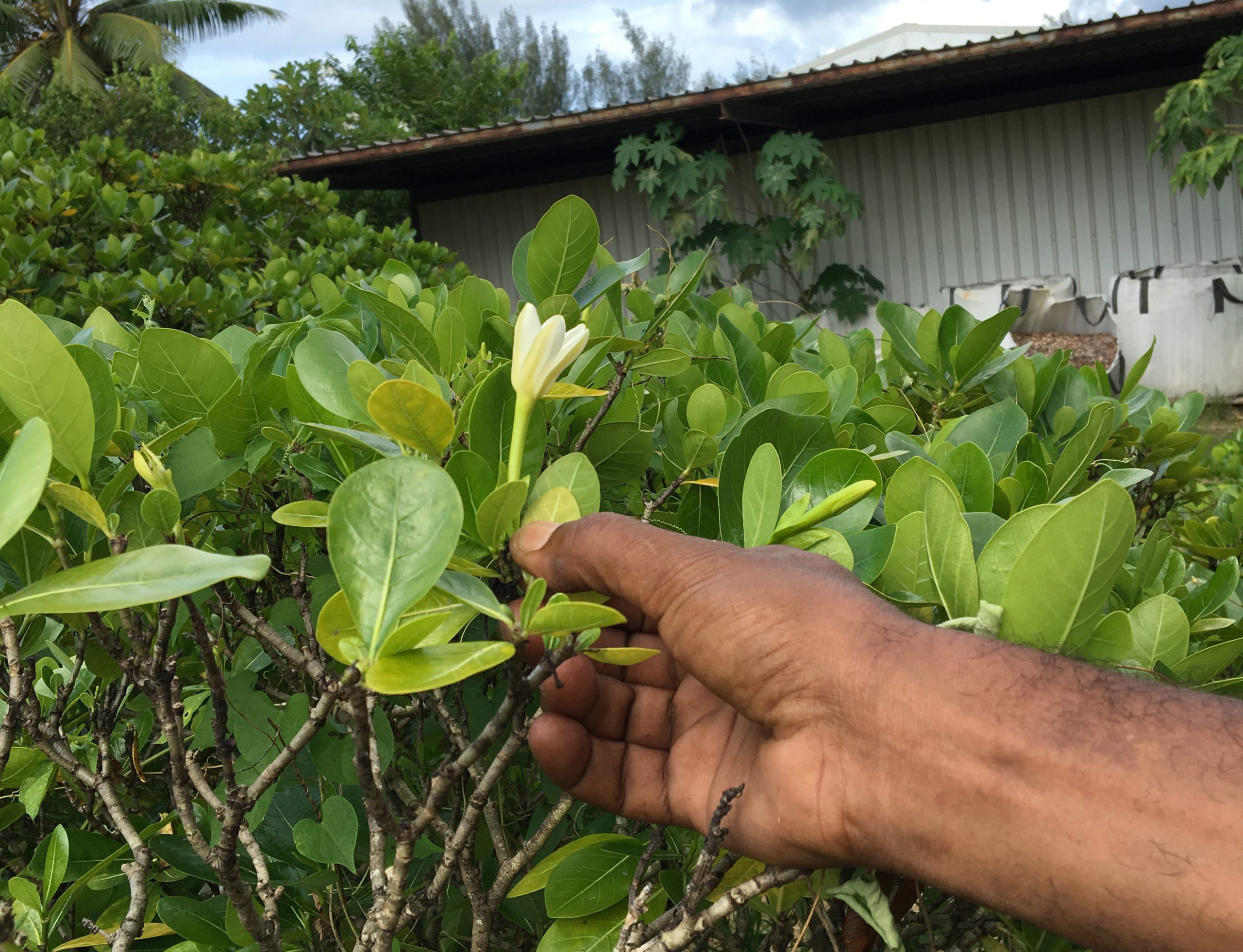
The Gardenia taitensis, also known as the Tahitian gardenia or tiare tahiti, is the national flower of French Polynesia and the Cook Islands. The plant is native to Melanesia and Western Polynesia; the Mā’ohi, the inhabitants of the South Seas, spread it across the Cook Islands, French Polynesia, and possibly Hawaii during their long sea voyages.

coco

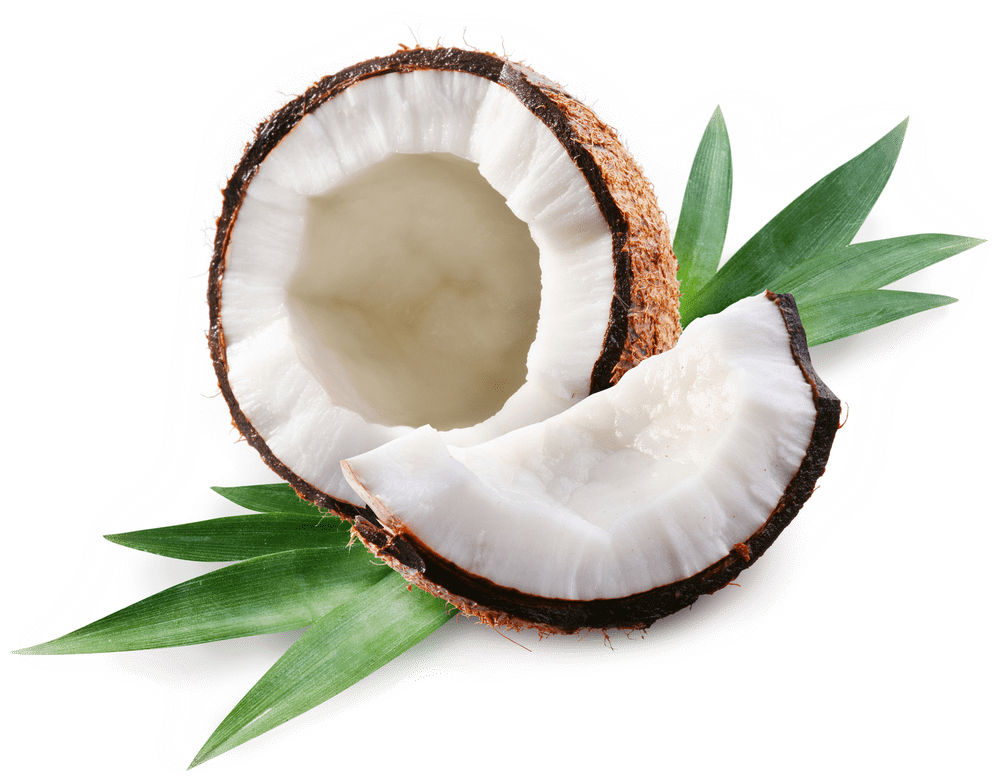
"The white gold of Tahiti" - the Coconut (Cocos nucifera) – is a fruit native to Tahiti and its islands. It yields an oil of unparalleled fineness. This golden-colored oil, rich in essential fatty acids, is prized above all for its nourishing and moisturizing properties.

Gardenia taitensis

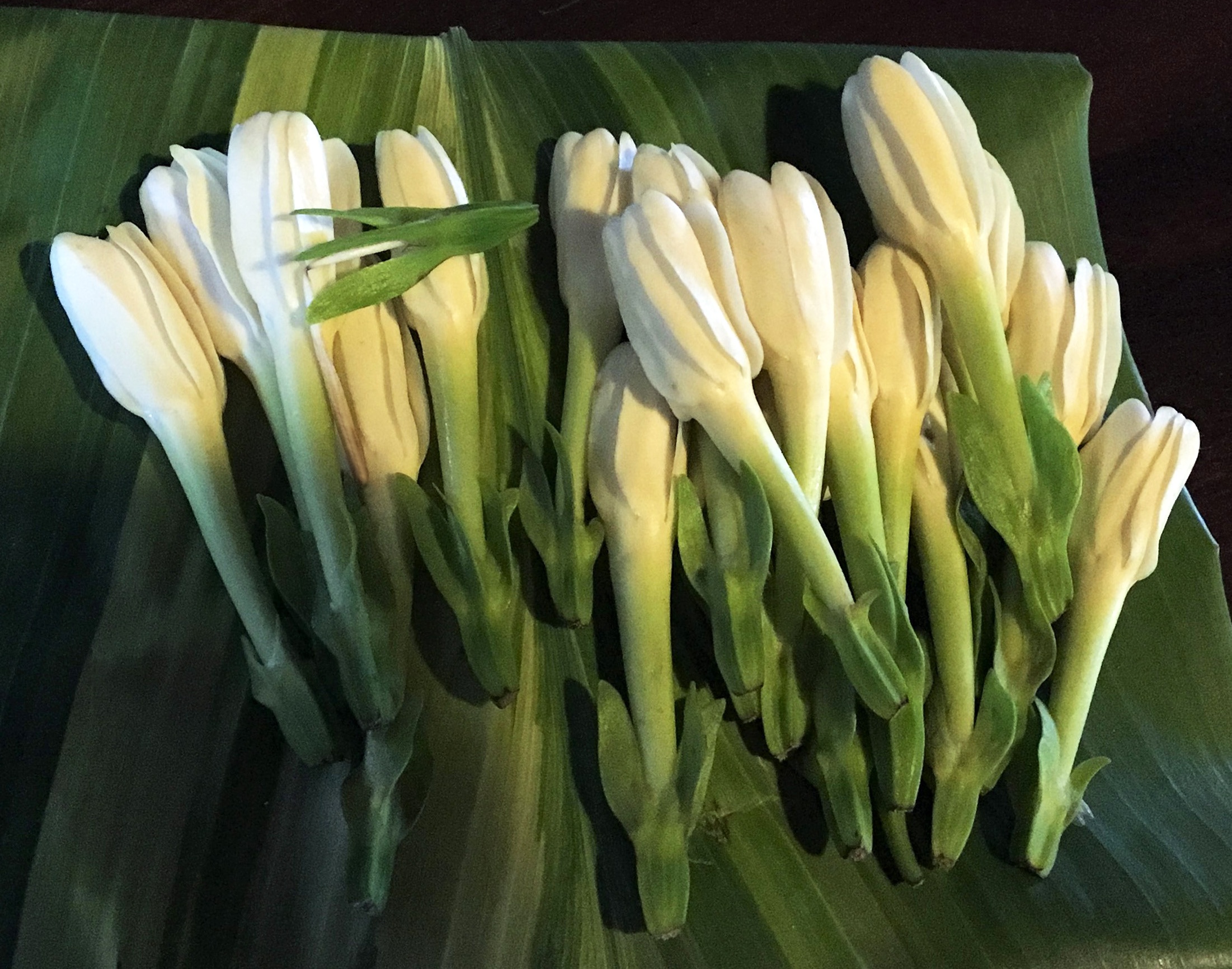
The Tiare flower – the symbol of French Polynesia – exudes a sweet, distinctive fragrance. People on the Pacific islands traditionally use the fragrant flowers to make their flower garlands, which are called „ei“ on the Cook Islands, „hei“ in Tahiti, and „lei“ in Hawaii. According to local tradition, wearing a flower behind the ear indicates one’s relationship status: on the left means „taken,“ on the right „single.“.

The Gardenia taitensis is the source of the unique Monoï de Tahiti: an oil naturally scented by infusing fresh tiare flowers in Coconut oil is obtained.

IMG 2489 cut to size

Production of Monoï de Tahiti

Anakena Monoï de Tahiti is a macerate made from tiaré flowers (Gardenia tahitensis) and refined coconut oil. The Monoï itself is produced exclusively in French Polynesia.

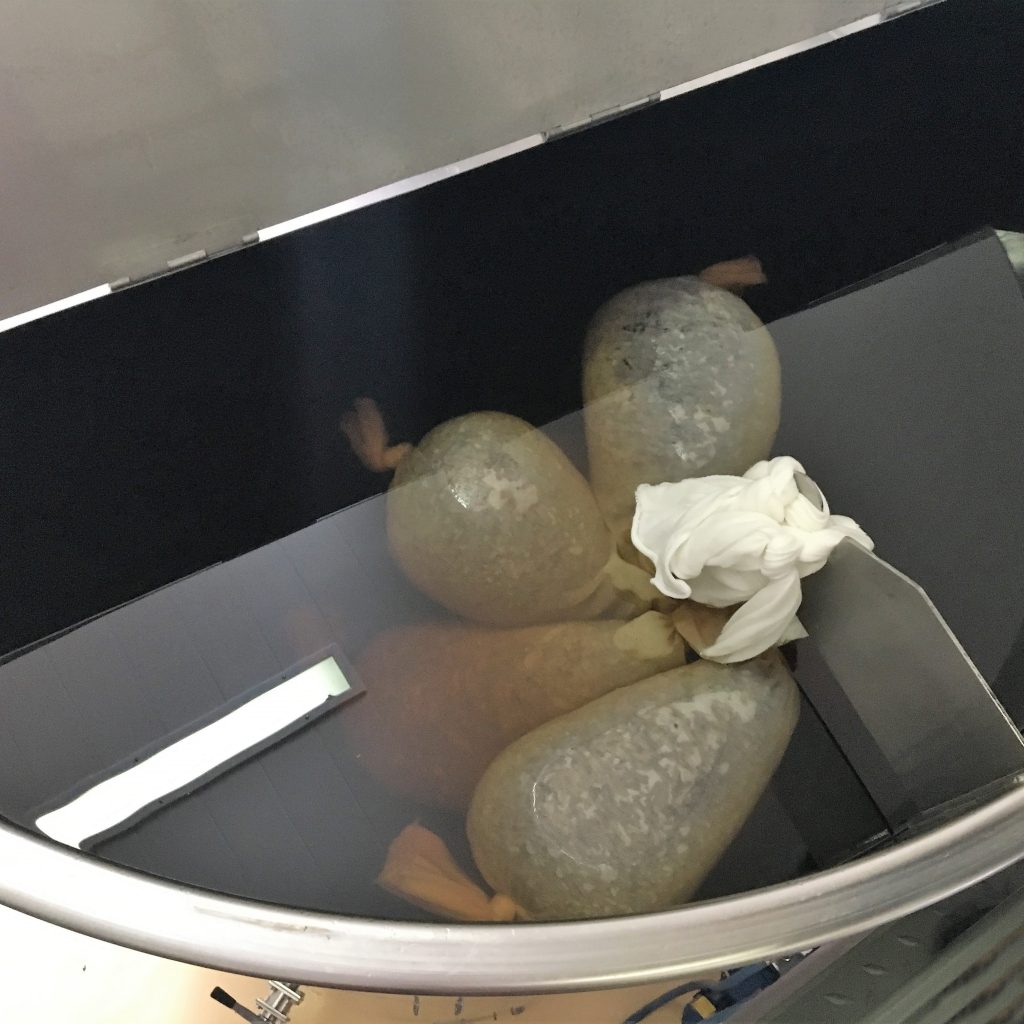
To do this, the tiare flowers are picked before dawn and steeped in coconut oil for 12 days using the traditional enfleurage method—with at least 12 flowers per liter. The entire process takes place at room temperature, without heating the oil. During this process, the flowers release their valuable compounds and their characteristic fragrance into the oil.

The macerate is then left to rest for 24 hours before being filtered, purified, and stabilized with tocopherol (vitamin E) as a natural antioxidant. Afterward, our Monoï is bottled in France for Anakena and shipped from there to Germany.

IMG 3063 Gardenia tahitensis (close-up, scaled)

Monoï de Tahiti oil is sold in the cosmetics industry both as a finished product and as an ingredient in the manufacture of creams, lotions, shampoos, and soaps. It is also found in our Face cream and Body lotion Anakena.

Appellation d'Origine

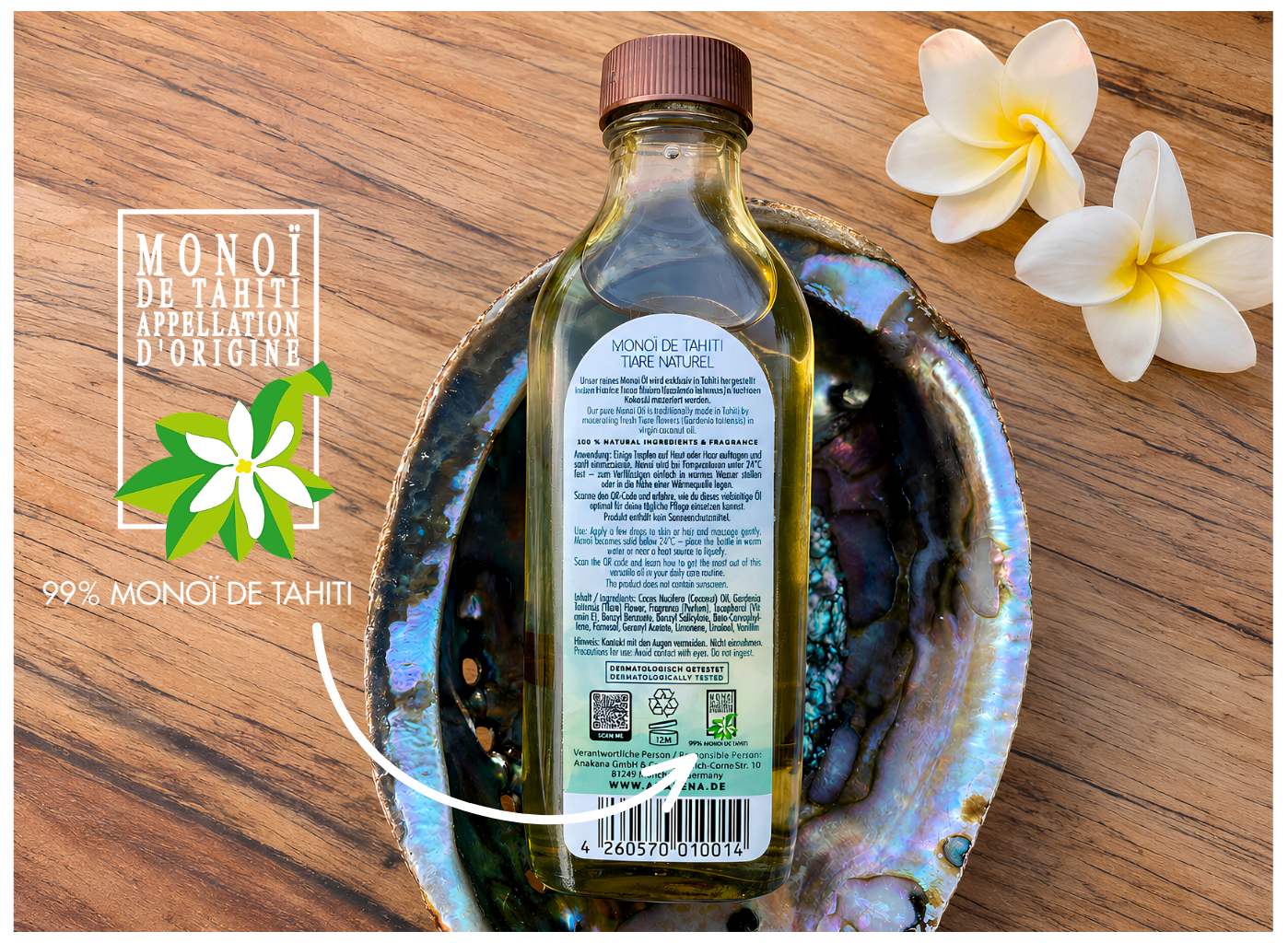
Our Anakena Monoï de Tahiti is made up of 99% of genuine Monoï de Tahiti and bears the protected French designation of origin „Appellation d’Origine.“.

The seal guarantees:
– From French Polynesia
– Use of traditional raw materials and manufacturing processes

You can learn more about the Appellation d’Origine and the associated rules regarding origin and production on our website Certifications.

Monoi Appellation Seal Anakena
Monoi shell front face

PREMIUM natural cosmetics

Our Monoï de Tahiti Anakena combines the nourishing benefits of traditional Polynesian recipes with the high standards of modern, premium natural cosmetics. The formula is based on all-natural ingredients, is dermatologically tested, and was specially developed for daily use on the skin and hair.

- Vegan
- 100 % of natural origin in the total product
- Dermatologically tested (very well tolerated by the skin)
- Free from silicones, kerosenes, phthalates, microplastics and mineral oils
- Free from parabens and genetically modified ingredients
- Without palm oil, gluten, lactose and sulphates

Polynesian Skincare Tradition

Monoï oil originated on the islands of the South Pacific. The Mā’ohi—the indigenous Polynesian people of French Polynesia—have been using it for generations to care for their skin and hair, as well as in traditional healing and religious rituals.

Monoï is one of the oldest preparations in rā’au Tahiti—the traditional Tahitian body of knowledge about plants and their traditional uses.

Ornament without flower

Important Note on Use

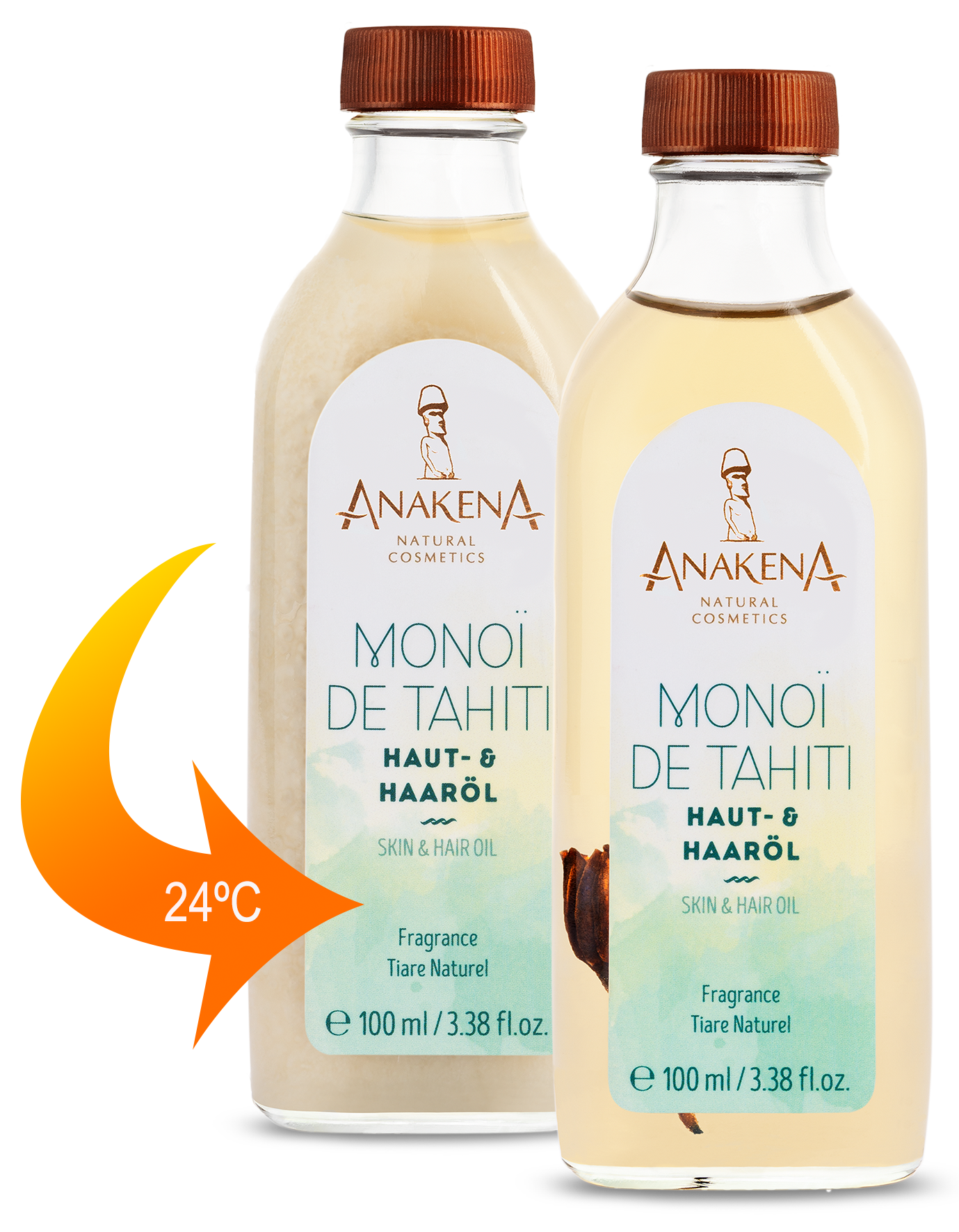
Our Monoï oil is solid at room temperature because it consists mainly of coconut oil, which has a higher melting point than, for example, olive or sunflower oil.

Before use, simply place the bottle in warm water or on a radiator for a few minutes until the oil is liquid (at approximately 24 °C or higher). It is then ready for your beauty and massage treatments.

Chart Monoi liquid and solid
Monoi in Tahiti

Possible applications

Our Monoï de Tahiti Anakena is a versatile oil for skin and hair care. It is suitable for daily body and hair care, relaxing massages, as a bath additive, and for soothing beauty rituals. It leaves your skin and hair feeling soft and nourished, with a delicate scent of tropical blossoms.

After shower

Rub the oil between your palms and apply it to skin that is still damp after a bath or shower. Then gently massage it in. Monoï spreads particularly evenly on damp skin and leaves it feeling velvety soft and nourished.

Hair care

Apply the Monoï oil to dry or damp hair and work it through from the scalp to the ends. Wrap a towel around your hair and let the oil sit for at least 15 minutes—or, for especially intensive care, preferably overnight.

Next, wash your hair thoroughly with Anakena Skin & Hair Shower Gel—twice if necessary. This hair treatment is especially recommended after a trip to the pool or beach. For the best possible results, we recommend using it once a week.

For curls and dry ends, rub the oil between your palms, massage it into the ends, and do not rinse.

Massage and Baby Massage

Anakena Monoï de Tahiti is ideal for relaxing massages for adults and children, as well as for gentle baby massages. Warm the oil in the palms of your hands and gently apply it to the areas of the body to be massaged.

You can find a personal case study in our blog post Baby Massage with Monoï de Tahiti Anakena.

Facial care

Apply the oil with your fingertips in gentle, circular motions to cleansed, slightly damp facial skin. Avoid the eye area. Especially for skin prone to dryness, you can then Face cream Anakena be used.

Bath additive

Add the Monoï de Tahiti to your warm bath water and enjoy the delicate tropical scent. After your bath, gently pat your skin dry with a towel so that the oil forms a protective layer on your skin.

Hand and Foot Care

We’d like to share a very special skincare tip with you—in the truest sense of the word—using our wonderful Monoï oil from Tahiti:

Massage the oil thoroughly into your hands or feet, paying special attention to your fingers and toes, nails, cuticles, and heels. For intensive care, it’s best to apply it in the evening before bedtime and let it work overnight. Afterward, simply put on a pair of socks.

For sunbathing and as an after-sun treatment

Monoï de Tahiti is also traditionally used in Polynesia while sunbathing and beautifully enhances the golden glow of tanned skin. After sunbathing, the oil can be applied to the shoulders, arms, legs, and décolleté, leaving the skin feeling pleasantly nourished.

Important: Monoï de Tahiti does not contain an SPF and does not provide protection against UV radiation. It is therefore never a substitute for a suitable sunscreen with an adequate SPF.

Francesca video
Instagram: @bio_rituali